
Course 1 - Data Literacy & Governance
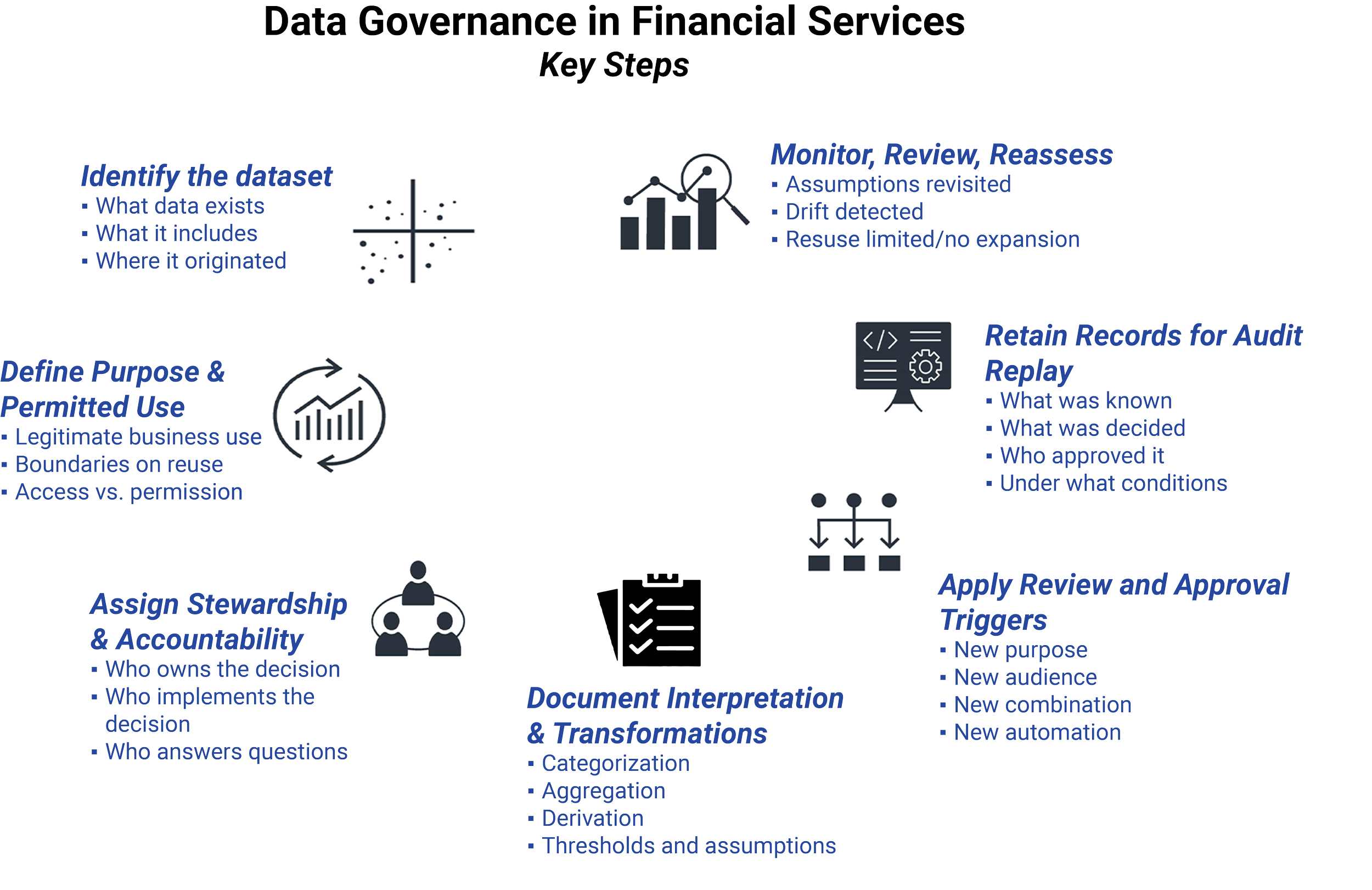
The governance lifecycle you’ve learned
Up to this point, Course 1 has focused on how regulators think about data: how meaning is created, where risk accumulates, and what firms must be able to explain and defend. Each lesson examined a different part of that lifecycle—from defining what data is, to understanding how it’s interpreted, governed, documented, retained, and reused.
This final lesson ties those ideas together.
If there is one core takeaway from this course, it’s this: most regulatory risk doesn’t begin with AI, automation, or analytics. It begins much earlier, with ordinary decisions about data. We’ve seen this play out in the financial world in many ways before the wide adoption of AI tools.
Across the eleven lessons, you’ve been building a regulator-aligned mental model for how data should be governed:
Identify the dataset: what exists, what it includes, and where it originated
Define purpose and permitted use: why the data exists and what boundaries apply
Assign stewardship and accountability: who’s responsible for oversight and escalation
Document interpretation and transformations: how meaning is introduced through categorization, aggregation, and derivation
Apply review and approval triggers: when changes in purpose, audience, or automation require governance intervention
Retain records for audit replay: preserving evidence of what was known, decided, and approved
Monitor, review, and reassess over time: ensuring assumptions don’t drift, and reuse doesn’t silently expand
This lifecycle is what regulators expect firms to be able to explain, and not as theory, but as practice.
What Comes Next
Course 1 established the data-level foundation. Later courses will build on this structure—applying the same governance logic to AI systems, automated workflows, and scaled content production. The concepts don’t change; the consequences simply get larger.
For now, the goal isn’t to build the perfect artifact. It’s to understand how regulators evaluate data use—and how firms can govern data deliberately before it scales.
You’ve completed Course 1: Data Literacy & Governance.
And more importantly, you now know how to look upstream, before the tools ever come into play.