
Course 1 - Data Literacy & Governance
Data ownership isn’t the same as permission
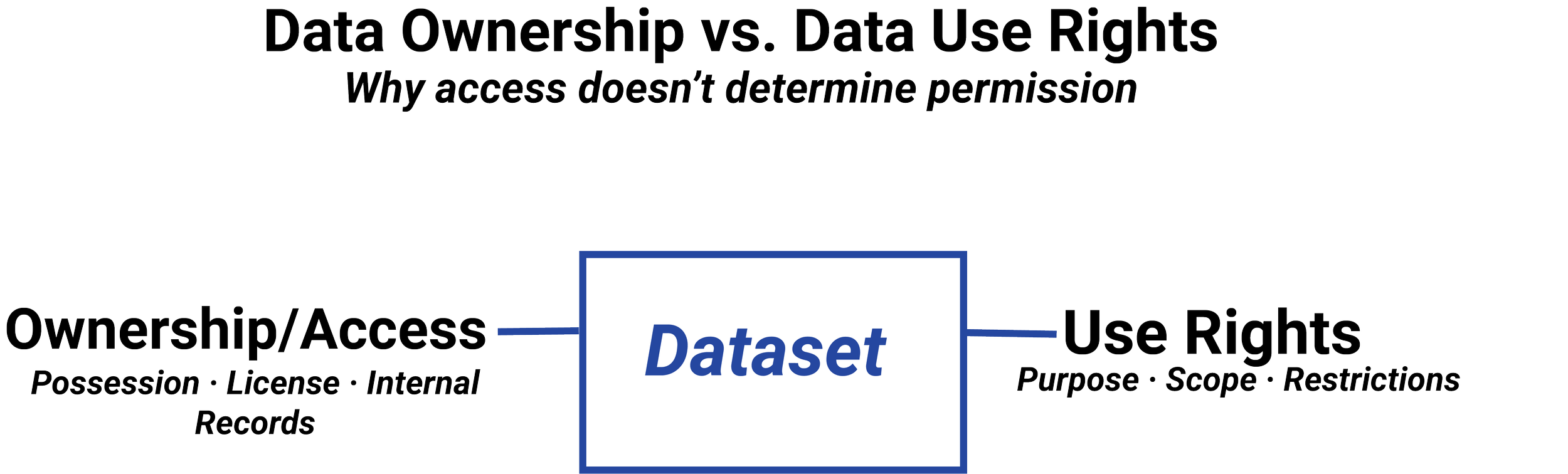
Data ownership generally refers to control over a dataset’s storage, maintenance, or custody. A firm may own internal records, maintain licensed third-party data, or store client information within its systems. Ownership determines who is responsible for safeguarding the data, but it doesn’t, by itself, determine how the data may be used.
Use rights are narrower and more specific. They define what purposes are permitted, what contexts are allowed, and what limitations apply. These rights are often established through regulation, contracts, client disclosures, or internal policy, and they may vary depending on how the data is interpreted or combined with other information.
The distinction matters because regulatory obligations attach to use, not possession.
How use rights are defined in practice
Data use rights are typically shaped by a combination of factors rather than a single rule. Regulatory requirements, client agreements, vendor licenses, and internal governance policies all contribute to defining what’s acceptable.
A dataset may be permitted for operational reporting but restricted from use in marketing or client segmentation. Another may be acceptable for internal research but prohibited from informing recommendations or prioritization. In each case, the data itself is unchanged. What changes is the context in which it is applied.
When firms fail to articulate these distinctions clearly, data is often reused informally, creating risk without deliberate intent.
Why regulators focus on use, not ownership
Regulators evaluate data through the lens of impact. They’re concerned with how information influences decisions, communications, and outcomes, particularly when clients or markets may be affected.
From this perspective, the fact that a firm owns or licenses data doesn’t resolve whether its use is appropriate. Regulators ask whether the data was used consistently with its permitted purpose, whether the use was documented and supervised, and whether accountability was clearly assigned.
Ownership may establish custody. Use establishes responsibility.
In regulated financial environments, access to data is often mistaken for permission to use it.
Firms may lawfully possess datasets, license third-party information, or generate internal records and assume that ownership or access alone determines how the data may be applied. Regulators don’t share that assumption. From a supervisory perspective, the critical question isn’t who holds the data, but what rights govern its use.
This lesson clarifies the distinction between data ownership and data use rights, and explains why misunderstanding that difference is a common source of regulatory exposure.
IN THIS LESSON
Common points of confusion
Confusion between ownership and use rights often emerges in routine workflows rather than high-risk scenarios. Data originally collected for compliance or operational purposes may later be reused for analytics, segmentation, or content development without a formal review of whether that new use is permitted.
Third-party data introduces additional complexity. Licensing agreements frequently impose purpose limitations that are easy to overlook once the data is integrated into internal systems. When data is later transformed or combined with other sources, those original constraints may no longer be visible to downstream users.
These gaps are rarely malicious, but they are precisely the kinds of weaknesses regulators expect firms to anticipate and control.
Why this matters before analytics or AI
Analytics and AI accelerate reuse. They make it easier to apply the same data across multiple contexts, teams, and outputs, often without explicit human review at each step.
If data use rights aren’t clearly defined and documented before analytics or automation are introduced, firms risk scaling unauthorized or poorly supervised use. By the time an issue is identified, the data may already have influenced numerous decisions or communications.
Establishing clear distinctions between ownership and permitted use upstream is what allows advanced tools to be deployed safely downstream.
Additional Resources
-
SEC — Books and Records Rule (Rule 204-2)
Reinforces that firms are accountable for how information is used and supervised, regardless of whether data is owned, licensed, or internally generated.SEC — Marketing Rule (Rule 206(4)-1) Overview
Establishes that regulatory obligations attach based on use and context, not data ownership, particularly in advertising, education, and performance-related materials.FINRA — Rule 2210: Communications with the Public
Applies supervisory standards based on how information is presented and relied upon, not on who owns the underlying data or analytics.
-
COSO — Internal Control Framework (Conceptual Guidance)
Emphasizes that effective control depends on defined authority, permitted use, and accountability, rather than possession of information alone.Office of the Comptroller of the Currency — Third-Party Risk and Model Governance Guidance
Reinforces that firms retain responsibility for how externally sourced data and analytics are applied, even when ownership resides with vendors.
-
European Data Protection Board — Purpose Limitation and Secondary Use Guidance
Establishes that lawful access or ownership does not imply unrestricted reuse; accountability increases when data is repurposed beyond its original intent.Information Commissioner's Office — Guidance on Data Sharing and Reuse
Treats data use rights as distinct from data possession, particularly where inferred or derived data is involved.
-
Industry Contracting and Licensing Practices — Data Use Restrictions
Vendor agreements commonly impose purpose, scope, and reuse limits that parallel regulatory expectations around data use rights.Enterprise Data Governance Literature — Ownership vs. Stewardship Models
Governance frameworks increasingly distinguish between data ownership, stewardship, and permitted use to support accountability.