
Course 1 - Data Literacy & Governance
In regulated finance, risk often arises not from what firms do with data, but from how much data they retain and how broadly it’s reused. Collecting or preserving information simply because it may be useful later is a common practice—and a common source of regulatory exposure.
Data minimization and purpose limitation are governance principles designed to address this risk. They require firms to be intentional about what data is collected, why it exists, and how long it is retained. This lesson explains why regulators expect these principles to be applied before analytics, automation, or AI are introduced.
IN THIS LESSON
What data minimization actually means
Data minimization is the principle that firms should collect and retain only the data necessary to achieve a defined and legitimate purpose. It is not a mandate to reduce data arbitrarily, nor is it an operational efficiency tactic.
From a regulatory perspective, minimizing data reduces unnecessary exposure. Every additional data element increases the surface area for misuse, misinterpretation, or unintended reuse. When data exists without a clear purpose, it becomes difficult to supervise and even harder to defend.
Minimization therefore functions as a control on future risk, not just a storage decision.
Purpose limitation as a governance boundary
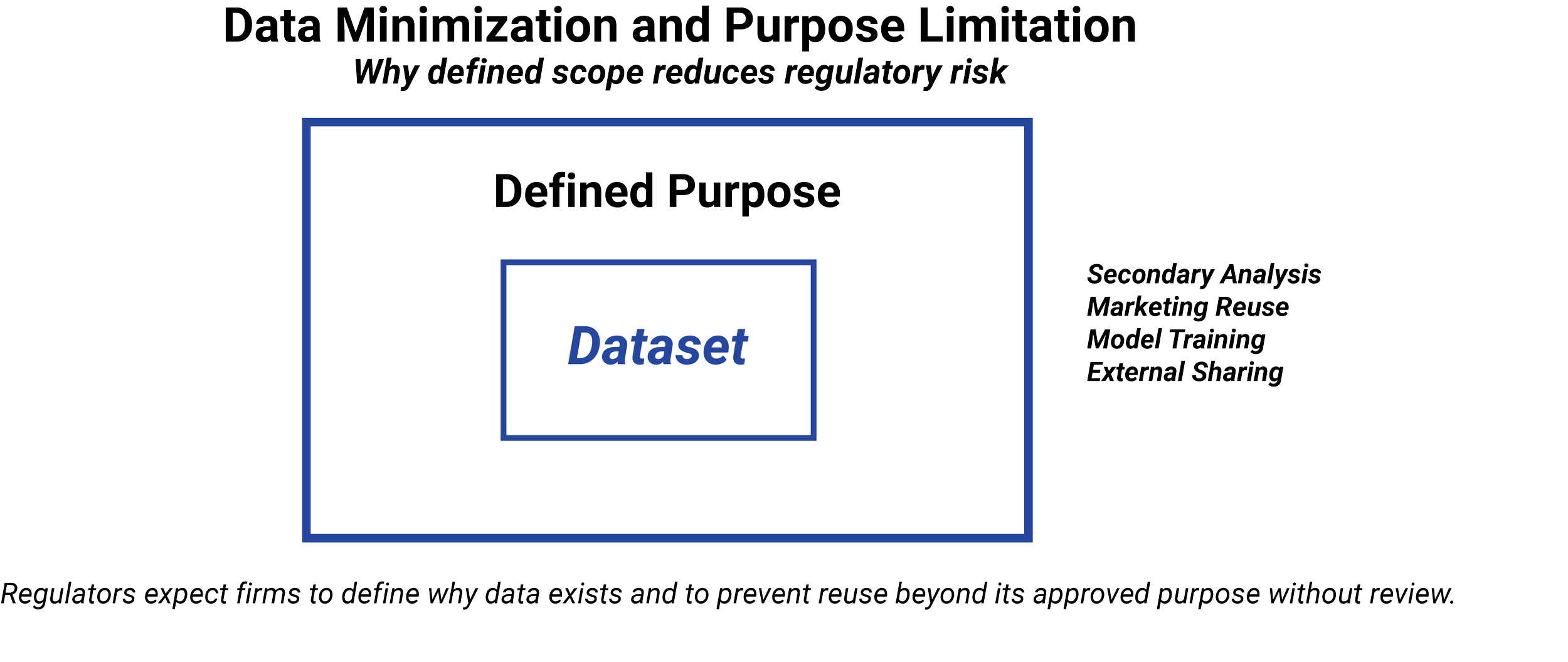
Purpose limitation complements minimization by restricting how data may be reused once collected. Data that is appropriate for one function may be inappropriate for another, even within the same organization.
A dataset collected to satisfy regulatory reporting requirements may not be suitable for marketing, segmentation, or decision support. Similarly, data gathered for operational efficiency may not be appropriate for influencing client-facing outcomes.
Purpose limitation requires firms to define these boundaries explicitly and to prevent informal or convenience-driven reuse that bypasses review.
Why excess data increases regulatory risk
Excess data creates ambiguity. When firms retain large volumes of information without clearly documented purposes, it becomes difficult to determine which uses are permitted and which are not.
This ambiguity undermines supervision. Supervisors cannot effectively oversee data usage if they cannot determine why the data exists or how it was intended to be used. In examinations, this often results in regulators questioning not just specific use cases, but the firm’s overall governance discipline.
Limiting data to defined purposes reduces the need for retrospective justification.
Common failures in minimization and limitation
Failures in data minimization and purpose limitation rarely stem from deliberate misconduct. More often, they emerge through incremental decisions: retaining data “just in case,” combining datasets for convenience, or reusing information without reassessing its original purpose.
Over time, these practices create sprawling data environments where oversight becomes reactive rather than preventative. When analytics or AI systems are later introduced, they inherit these weaknesses and amplify them.
Regulators expect firms to recognize and correct these patterns proactively.
Why this matters before analytics or AI
Analytics and AI systems are inherently opportunistic. They surface patterns across whatever data is available, regardless of whether that data was collected for the task at hand.
For example, without minimization and purpose limitation, systems may draw in irrelevant or inappropriate information, producing outputs that are difficult to explain or defend. Once automated processes rely on such data, correcting misuse becomes significantly more complex.
Establishing clear limits on data collection and reuse is what allows advanced tools to operate within defensible boundaries.
Additional Resources
-
· SEC — Books and Records Rule (Rule 204-2)
Establishes that retention obligations apply to records that are required to be created and maintained for regulatory purposes, reinforcing that firms are expected to retain what is necessary — not everything that is technically possible to store.· SEC — Safeguards Rule (Regulation S-P)
Addresses the protection of customer information and implicitly supports minimization by emphasizing limits on access, use, and retention of sensitive data beyond what is required for business or compliance purposes.· FINRA Rule 3110 — Supervision (Conceptual Overview)
Requires firms to establish supervisory systems reasonably designed to ensure compliance, which becomes difficult when data environments are overly broad, poorly scoped, or lack defined purpose boundaries.· FINRA Regulatory Notices on Data Use and Targeted Communications
Illustrate that the appropriateness of data use is evaluated based on context and purpose, not mere availability, reinforcing that data reuse without review can create supervisory exposure. -
· COSO — Internal Control Framework (Information & Communication Component)
Emphasizes that controls should be proportionate, purposeful, and aligned with defined objectives, supporting minimization as a governance discipline rather than an efficiency measure.· Basel Committee on Banking Supervision — Principles for Effective Risk Data Aggregation and Reporting (BCBS 239)
Highlights that data environments should be fit for purpose, controlled, and explainable, and that excessive or poorly governed data undermines effective risk management.· SEC Cybersecurity and Data Governance Guidance
Reinforces that holding unnecessary data increases security, operational, and compliance risk, and that governance expectations extend beyond technical safeguards to decisions about data scope and retention. -
· OECD — Principles on Data Governance
Provides a policy-level framework emphasizing purpose specification, accountability, and proportionality in data collection and use, reinforcing minimization as a governance expectation.· NIST — Data Risk Management and Privacy Framework Concepts
Introduces minimization and purpose limitation as foundational risk controls, particularly where data may later be repurposed for analytics or automated decision-making.· European Data Protection Board — Purpose Limitation and Data Minimization Guidance
Clarifies that data collected for one purpose does not automatically become permissible for others, and that excess data retention increases accountability and enforcement risk. -
· UK Information Commissioner’s Office — Guidance on Data Minimization and Purpose Limitation
Offers practical illustrations of how excess data retention and informal reuse create regulatory exposure, particularly in analytics and profiling contexts.· International Association of Privacy Professionals — Articles on Purpose Creep and Secondary Use Risk
Explores how well-intentioned data reuse often leads to governance failures when original collection purposes are forgotten or undocumented.· Academic and Industry Commentary on “Data as Liability”
A growing body of thought leadership reframes excess data not as an asset, but as a source of operational, compliance, and reputational risk when governance does not keep pace with accumulation.