
Course 1 - Data Literacy & Governance
IN THIS LESSON
When regulators examine how a firm uses data, they’re rarely interested only in outputs.
They want to know where the data came from, how it moved through the organization, and what changed along the way.
This is the purpose of data lineage and provenance. They provide a defensible narrative of how information became decisions, communications, or actions.
Without that narrative, even technically correct analysis can become a compliance problem.
Data lineage as an accountability narrative
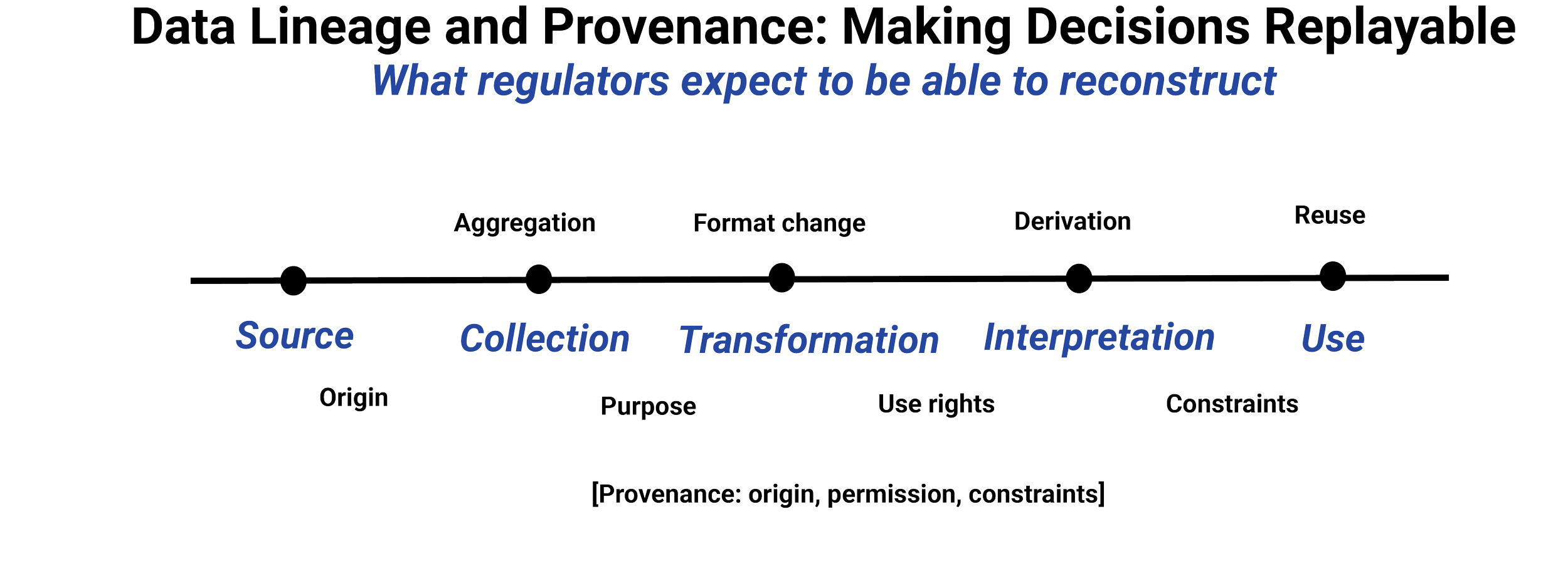
Data lineage describes the path information takes from its original source through the systems, transformations, and processes that ultimately shape its use. It is not merely a technical artifact created for data engineers, but a governance record that supports accountability.
A complete lineage narrative allows a firm to demonstrate how data entered the organization, how it was processed or enriched, which controls applied at each stage, and where responsibility rested. When lineage is missing or incomplete, firms lose the ability to explain how specific outputs were produced at a particular point in time. This creates vulnerability during audits, examinations, and internal reviews, even when no misconduct has occurred.
Provenance and the legitimacy of use
While lineage focuses on movement, provenance focuses on origin and legitimacy. Provenance establishes where data came from, under what authority it was obtained, and for what original purpose. These factors matter because regulatory permission is often tied not to technical access, but to intended use.
Data that is lawfully collected for one purpose may be restricted from use in another. Provenance records provide the basis for determining whether a given use remains consistent with contractual, regulatory, or ethical constraints. When provenance is unclear or undocumented, firms may inadvertently use data in ways that exceed their rights, even when the data itself appears innocuous.
Why lineage and provenance must be considered together
Lineage and provenance are complementary but insufficient on their own. A firm may be able to trace data precisely through multiple systems while still lacking a defensible justification for its use. Conversely, a firm may have legitimate rights to a dataset but lack visibility into how it was transformed, combined, or reused across teams.
Regulators expect both dimensions to be addressed. Together, they allow examiners to understand not only what happened to the data, but whether it should have happened at all.
Regulatory focus and examination risk
From a regulatory perspective, lineage and provenance serve several critical functions. They enable audit replay by allowing regulators to reconstruct how a specific decision or communication was generated at a given moment. They support accountability by clarifying where interpretation occurred and who was responsible for oversight. They also help surface risk concentrations, as gaps in lineage or unclear provenance often indicate informal processes, undocumented transformations, or unreviewed assumptions.
These gaps are rarely isolated. They tend to emerge in environments where data reuse accelerates faster than governance, making them early warning signs of broader control weaknesses.
Where lineage commonly breaks down
Most organizations are capable of collecting and storing data. The more common challenge is maintaining visibility into how that data is used over time. Lineage often erodes through informal practices such as ad hoc data pulls, spreadsheet-based analysis that bypasses formal systems, or the quiet addition of derived fields whose logic is never recorded.
Individually, these practices may seem harmless. Collectively, they undermine a firm’s ability to explain how information was interpreted and applied, particularly when the same datasets are reused for new purposes.
Why this matters before analytics or AI
Analytics and AI systems amplify the consequences of weak lineage and provenance. Automated processes reuse data at scale, propagate assumptions rapidly, and obscure human judgment behind technical complexity. When regulators ask how an output was produced, references to models or tools are insufficient without a documented history of data movement and permission.
Establishing lineage and provenance before introducing analytics or AI is not a constraint on innovation. It is what allows innovation to occur without compromising accountability.
Additional Resources
-
SEC — Books and Records Rule (Rule 204-2)
Requires firms to retain records sufficient to reconstruct decisions and communications, making lineage and provenance essential for audit replay and examination review.SEC — Division of Examinations Risk Alerts (Data Analytics and AI)
Examination materials repeatedly emphasize the ability to explain how information moved through systems, where interpretation occurred, and how outputs were generated.FINRA — Rule 3110: Supervision
Establishes expectations for supervisory systems that can trace how information supports decisions, communications, and recommendations over time.
-
Office of the Comptroller of the Currency — Model Risk Management (SR 11-7)
Introduced the supervisory expectation that firms must document data inputs, transformations, assumptions, and limitations to support accountability and explainability.Federal Reserve Board — Supervisory Guidance on Modeling and Stress Testing
Emphasizes traceability of data from source through transformation to output, particularly where automated or model-driven decisions are involved.
-
Basel Committee on Banking Supervision — Principles for Risk Data Aggregation and Reporting (BCBS 239)
Establishes global expectations around data lineage, aggregation, and traceability as prerequisites for effective risk governance and supervisory review.European Data Protection Board — Accountability and Purpose Limitation Guidance
Reinforces that organizations must be able to demonstrate how personal data was sourced, transformed, and repurposed, aligning closely with provenance concepts.
-
National Institute of Standards and Technology — AI Risk Management Framework (AI RMF)
Highlights the importance of documenting data flows, transformations, and assumptions to support explainability and accountability in automated systems.Enterprise Data Governance Literature — Lineage and Metadata Management
Industry governance frameworks consistently identify lineage gaps as early indicators of control weaknesses and unmanaged risk.